Vignesh Vijayendran
← Back to work
PRODUCT DESIGN / HEALTH & WELLBEING
LifeFit
An approachable fitness experience
for adults above 40.
A safety-conscious design concept exploring how manageable routines, clear guidance, and personal preferences can make fitness easier to begin.

9:41

My plan
Your personalized weekly routine

V
WEEK 1 • PERSONALIZED PLAN
2 of 4 workouts
50%
This week
2 of 4 workouts
Mon
24
Tue
25
Wed
26
Thu
27
Fri
28
Sat
29
Sun
30
Your week
Manage
TUE
25
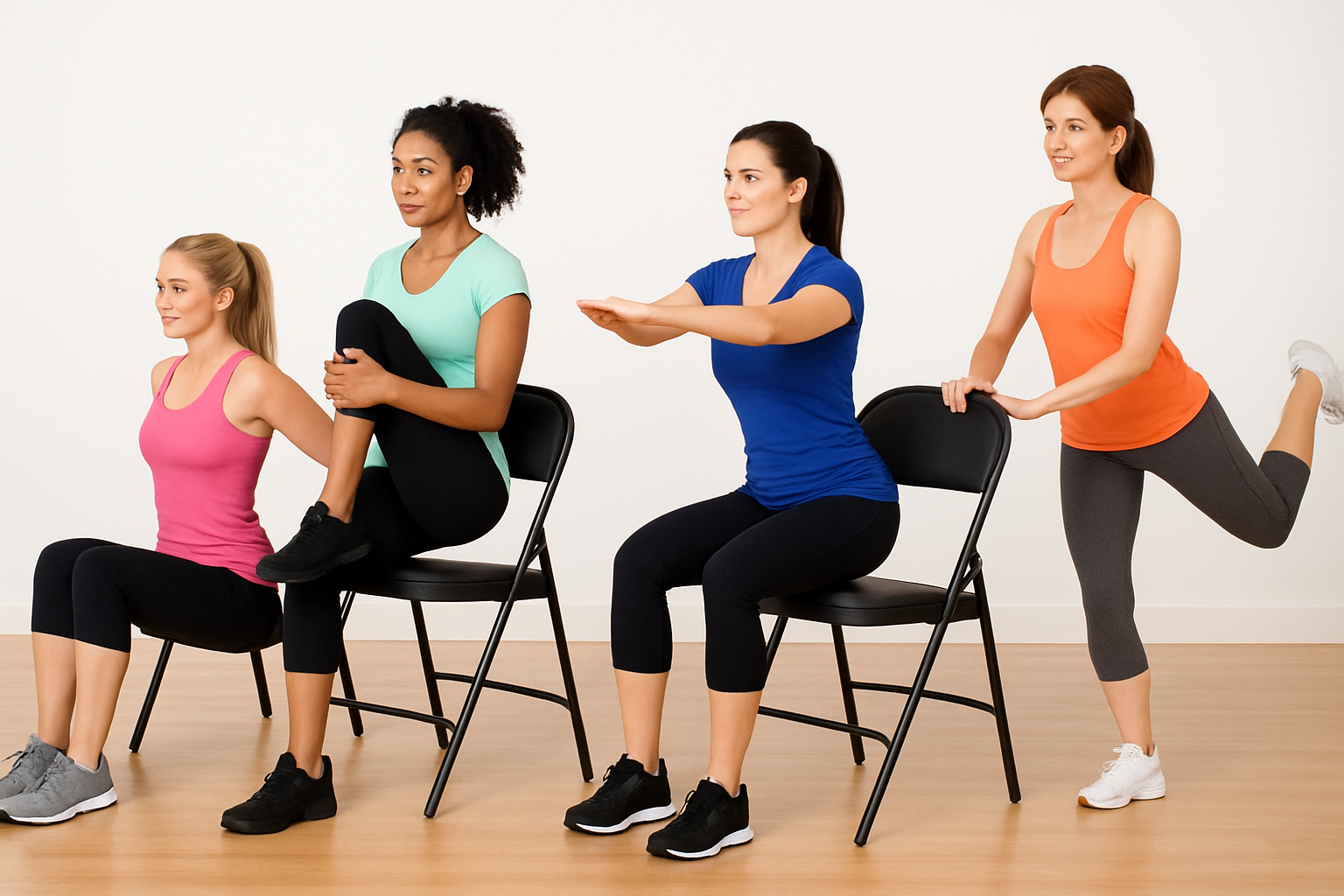
Lower-body strength reset
28 min • Beginner
Completed
THU
27
Chair mobility flow
20 min • Gentle
Today
SAT
29
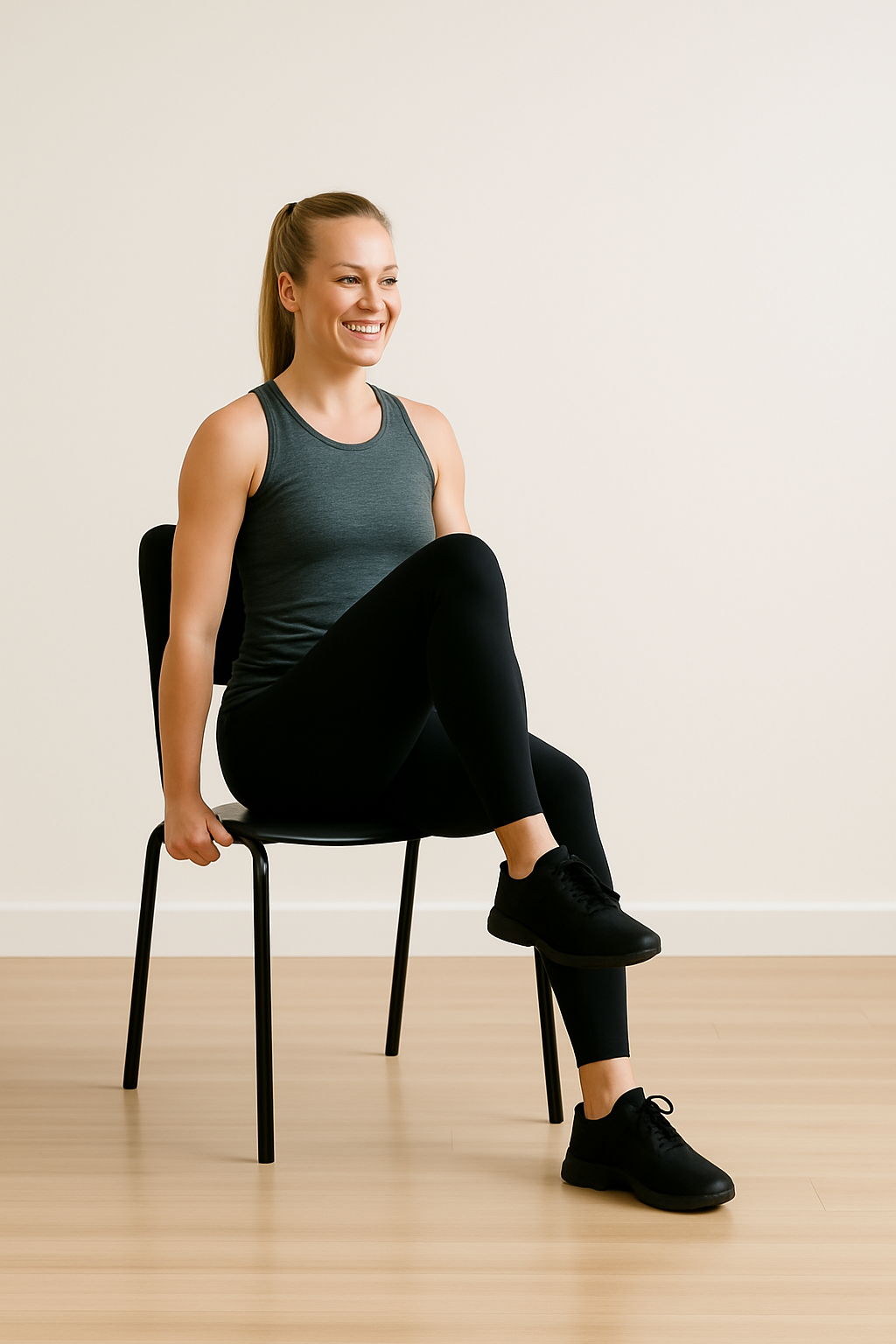
Posture and balance
24 min • Beginner
Upcoming
SUN
30
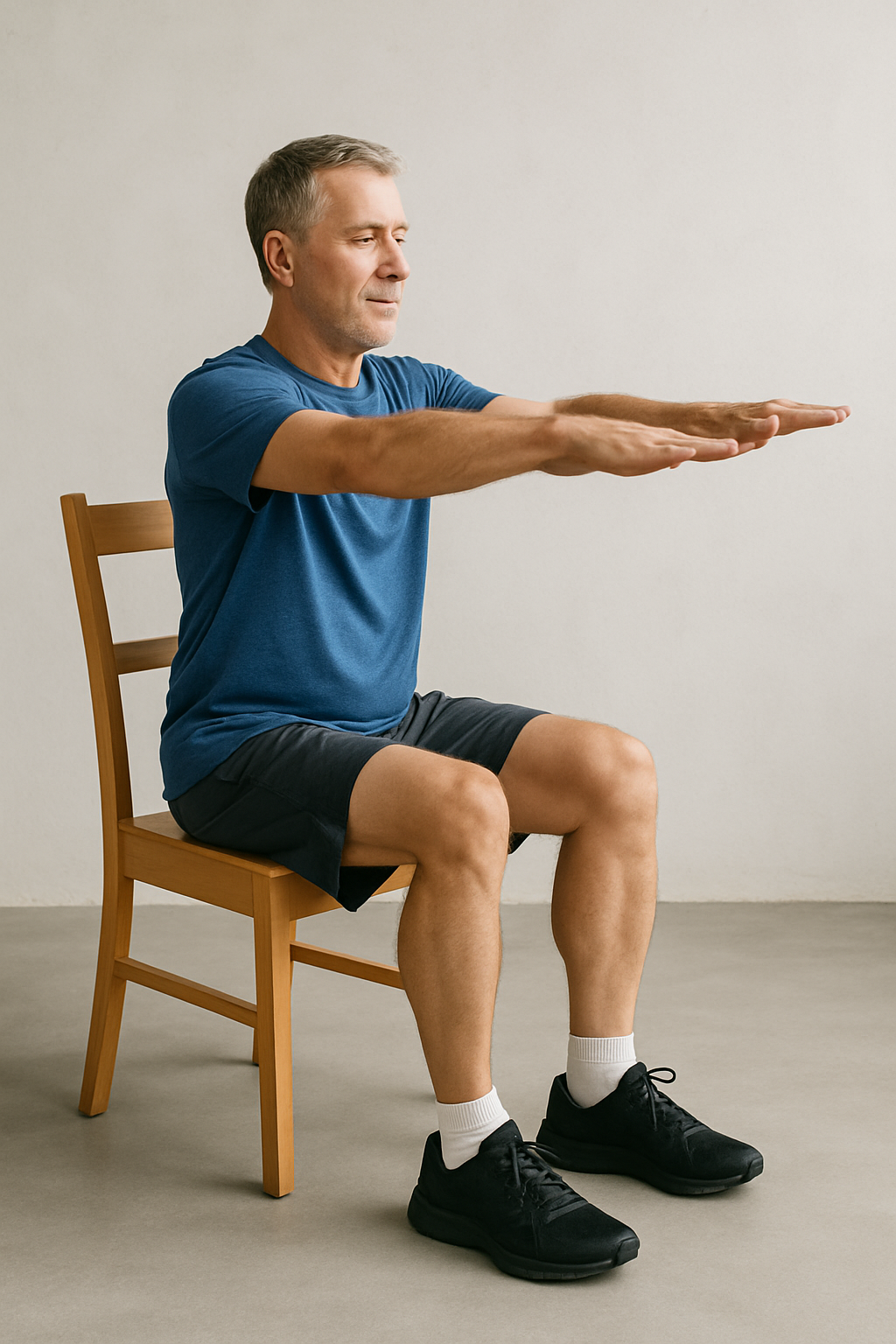
Indoor walking
18 min • Easy
Upcoming
Plan focus
Strength
2 sessions
Mobility
1 session
Balance
1 session
Your plan adapts with you
Workout difficulty and recovery days adjust using your feedback and progress.

Home

Workouts

Plan

Profile
9:41

Good morning, Vignesh
Your personalized plan is ready.

V
WEEK 1 • PERSONALIZED PLAN
2 of 4 workouts
50%
Today’s workout
View plan
DAY 1
Lower-body strength reset
28 min • Beginner • Chair
Start Workout
This week
2 of 4 workouts
Mon
24
Tue
25
Wed
26
Thu
27
Fri
28
Sat
29
Sun
30
Support your day


Recovery
Ready to train

Recovery
Ready to train
Weekly progress
View plan
Your first week
2 of 4 workouts


TODAY
Lower-body strength reset
›

THU
Mobility & balance
›
SAT
Upper-body posture
›
SUN
Recovery walk
›


50%

Home

Workouts

Plan

Profile
I took LifeFit from an initial idea to an interactive prototype, owning product framing, secondary research, information architecture, user flows, UI design, the design system, and prototyping.
01 / WHY I STARTED
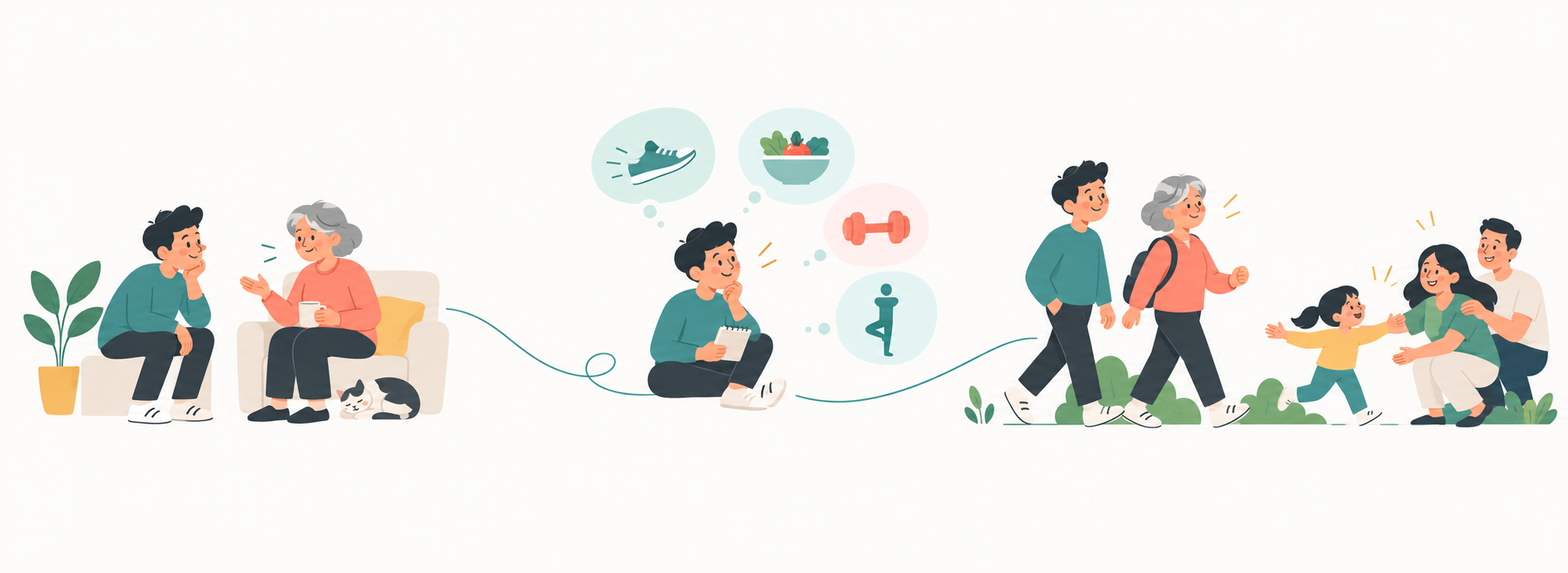
A personal question about living well beyond 40.
LifeFit began with a question: how can we help people stay strong, active, and independent as they grow older?
With my mother in her 60s, this curiosity became deeply personal. I started thinking about everyday movement, nutrition, and sustainable habits that could support her health and confidence.
My intention was simple: help people build healthier habits so they can keep doing the things they enjoy and spend meaningful time with family.
02 / THE PROBLEM I OBSERVED
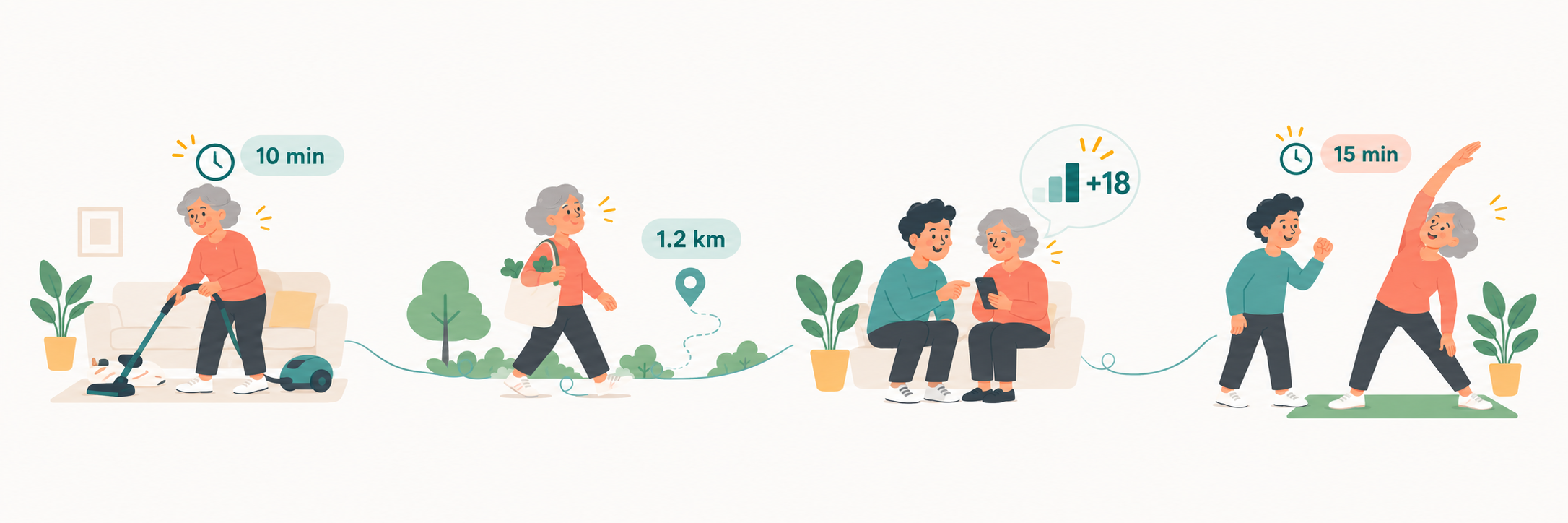
Small steps often go unnoticed.
From my perspective, walking to a nearby shop, carrying groceries, or choosing a more nourishing meal could feel too ordinary to count as part of a healthier routine.
When fitness is understood mainly as structured exercise, getting started can feel like a bigger commitment than it needs to be. I wanted to explore how small, manageable changes could feel worth taking.
Who I designed for
Adults above 40 who want to build healthier habits without making fitness the centre of their lives, with varied abilities, routines, and confidence. This is an initial audience focus, not a validated persona.
03 / THE DESIGN CHALLENGE
How might we help adults above 40 build healthier habits through manageable, safety-conscious plans that fit their bodies and everyday lives?
Understand each person’s starting point, offer realistic choices, and make room to pause, stop, or respond to difficulty. The goal is support, not pressure to finish.
04 / RESEARCH & EARLY UNDERSTANDING
Secondary research. Everyday observation.
I explored healthy aging, activity, strength, balance, and nutrition through online research. Alongside this, I informally observed adults training at the same gyms as me in Bangalore. Thinking about my mother’s health added a personal lens.
These inputs helped frame the initial direction. I did not conduct a formal interview study; the assumptions guiding LifeFit remain unvalidated.
Original references are pending recovery. Follow-up reading will be identified separately.
05 / EARLY INSIGHTS & DESIGN PRINCIPLES
A supportive experience, by intention.
Start small. Make the next step clear.
Recognize manageable effort and avoid making the first step feel like a major commitment.
Understand the person, not just their age.
Consider activity, strength, limitations, comfort, and practical preferences before shaping a plan.
Keep users in control.
Make pause and exit accessible. Capture difficulty without pressuring people to complete a session.
Make consistency visible.
Show completed effort clearly. Treat these principles as hypotheses to test, not proven outcomes.
06 / THE DESIGNED SOLUTION
Understand before recommending.
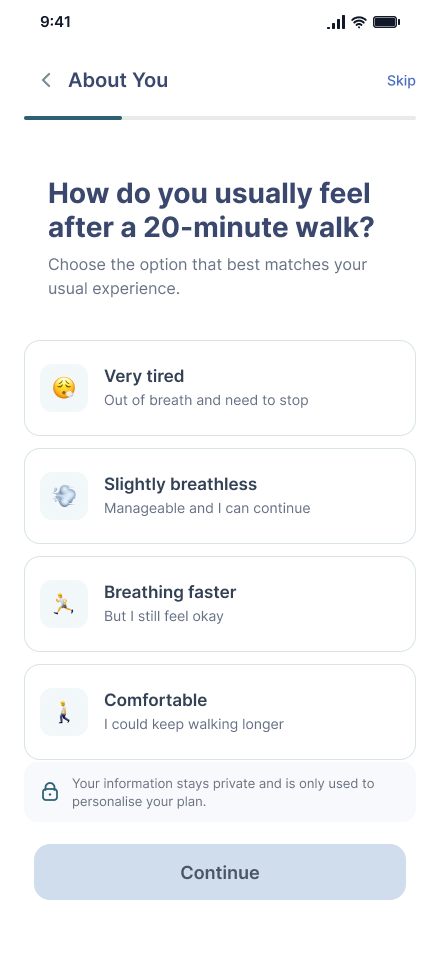
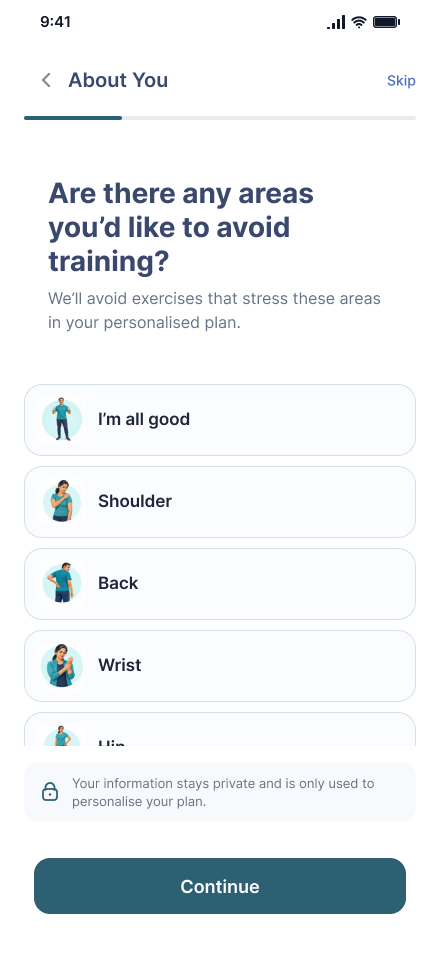
The assessment looks beyond age: daily activity, perceived exertion, strength, health considerations, areas to avoid, recovery needs, and preferences.
Start with familiar experience
A 20-minute walk question gives people an everyday reference for perceived exertion. Intended to make self-reporting easier, not act as a clinical test.
Acknowledge limitations early
Areas users wish to avoid bring physical considerations into planning. Exercise-selection rules still need qualified review.
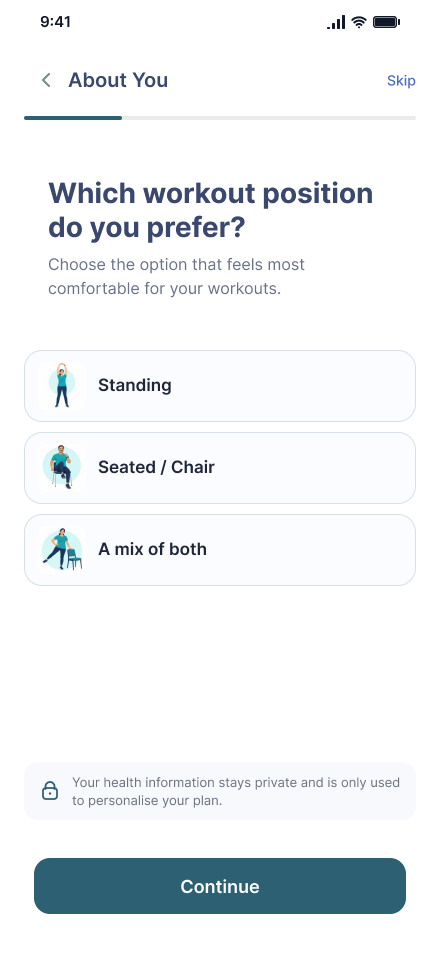
Offer ways to participate
Standing, seated, and mixed preferences acknowledge different comfort levels. Intended to make starting feel more approachable.
THE EXPERIENCE / PERSONALIZED PLAN
One clear next step, within a weekly routine.
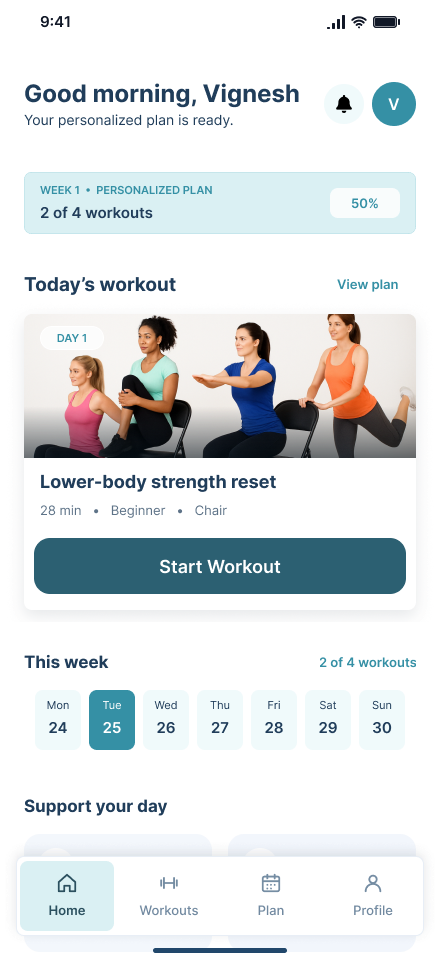
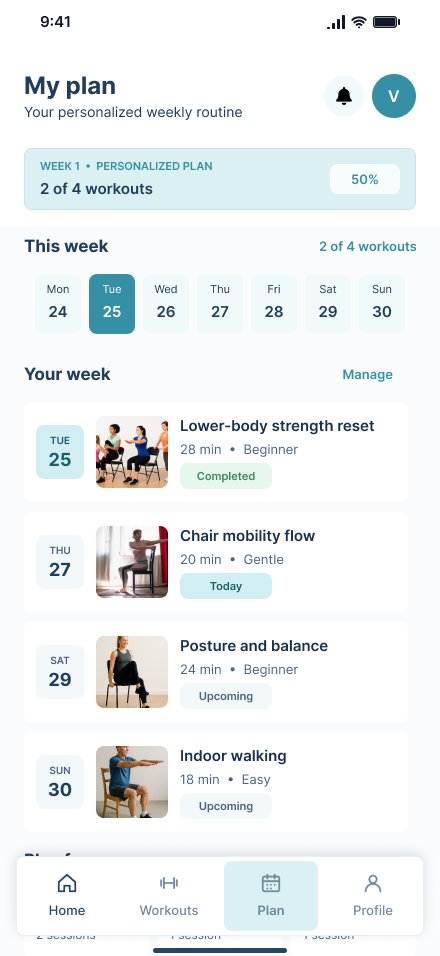
After assessment, the plan-ready transition lets users choose View Plan. Today’s workout then brings the activity, duration, level, and start action together, while weekly progress provides context.
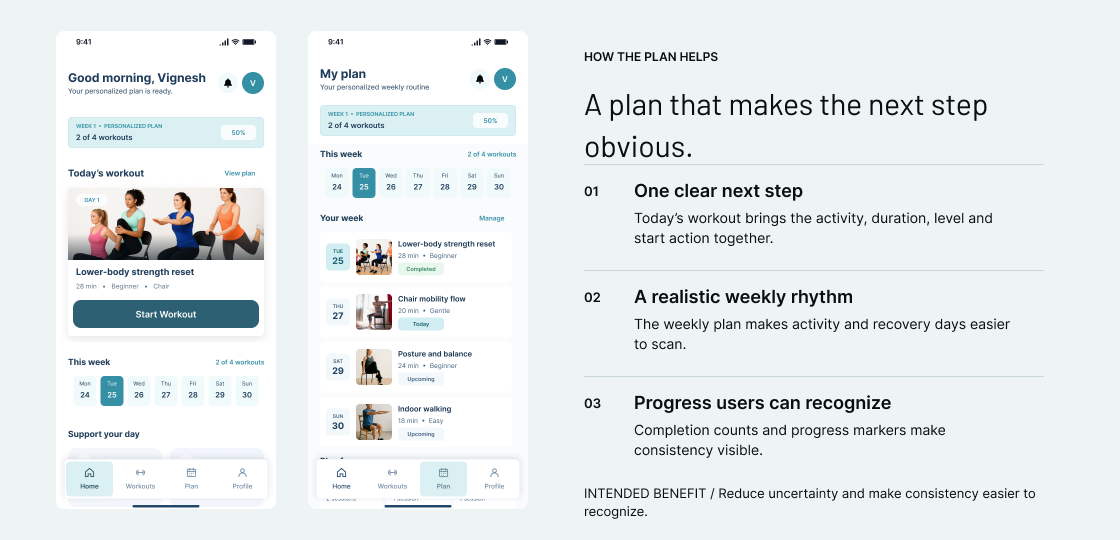
HOW THE PLAN HELPS
A plan that makes the next step obvious.
01 One clear next step
Today’s workout brings the activity, duration, level and start action together.
02 A realistic weekly rhythm
The weekly plan makes activity and recovery days easier to scan.
03 Progress users can recognize
Completion counts and progress markers make consistency visible.
THE EXPERIENCE / WORKOUT & FEEDBACK
Guidance without pressure to keep going.
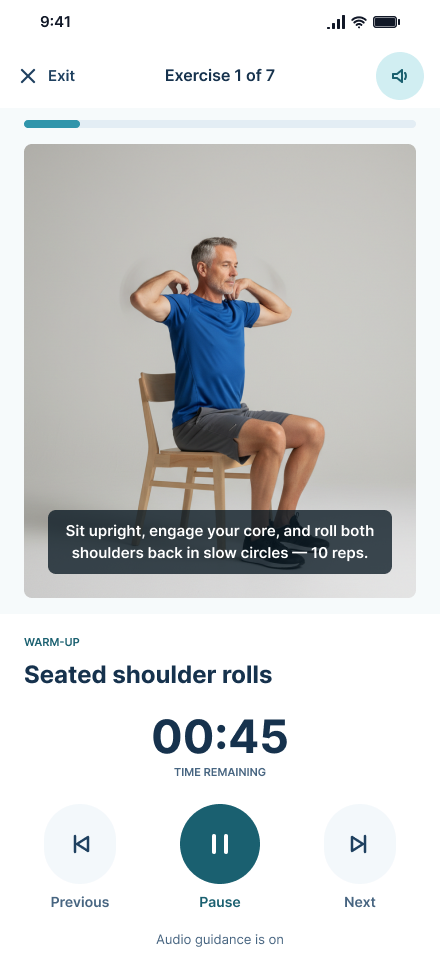
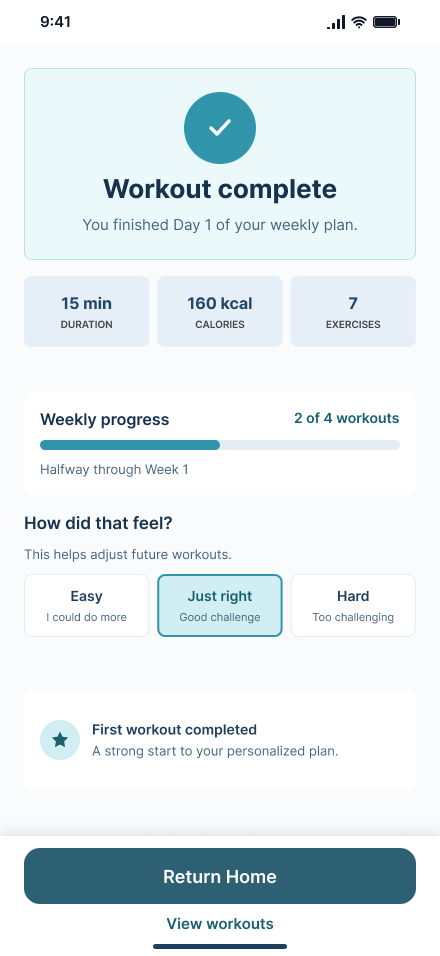
Visual instructions, a timer, and audio guidance support the workout. Pause and Exit keep control with the user. Afterward, Easy / Just right / Hard captures how the session felt.
DURING WORKOUT
Guidance that stays in reach
01
Guidance in context
Visual demonstration and movement cues support the exercise.
02
Control stays visible
Previous, Pause, Next and Exit remain available.
03
Audio support
Audio guidance provides another way to follow along.
Keep users in control.
Intended benefit: make guidance easier to follow while allowing a break or an early stop.
AFTER WORKOUT
Feedback that informs the next step
01
Recognize effort
Completion and weekly progress acknowledge the session.
02
Capture difficulty
Easy, Just right and Hard record perceived challenge.
03
Return to the plan
A clear action takes users back to their routine.
Recognize effort and listen.
Intended benefit: capture perceived difficulty to inform future adjustments.
PROTOTYPE SCOPE / Sample plans demonstrate the journey. Personalized plan generation, adaptive adjustments, and health outcomes are not implemented or validated. Everyday activity logging remains a future opportunity.
07 / REFLECTION & NEXT STEPS
Designing for healthy aging meant looking beyond age.
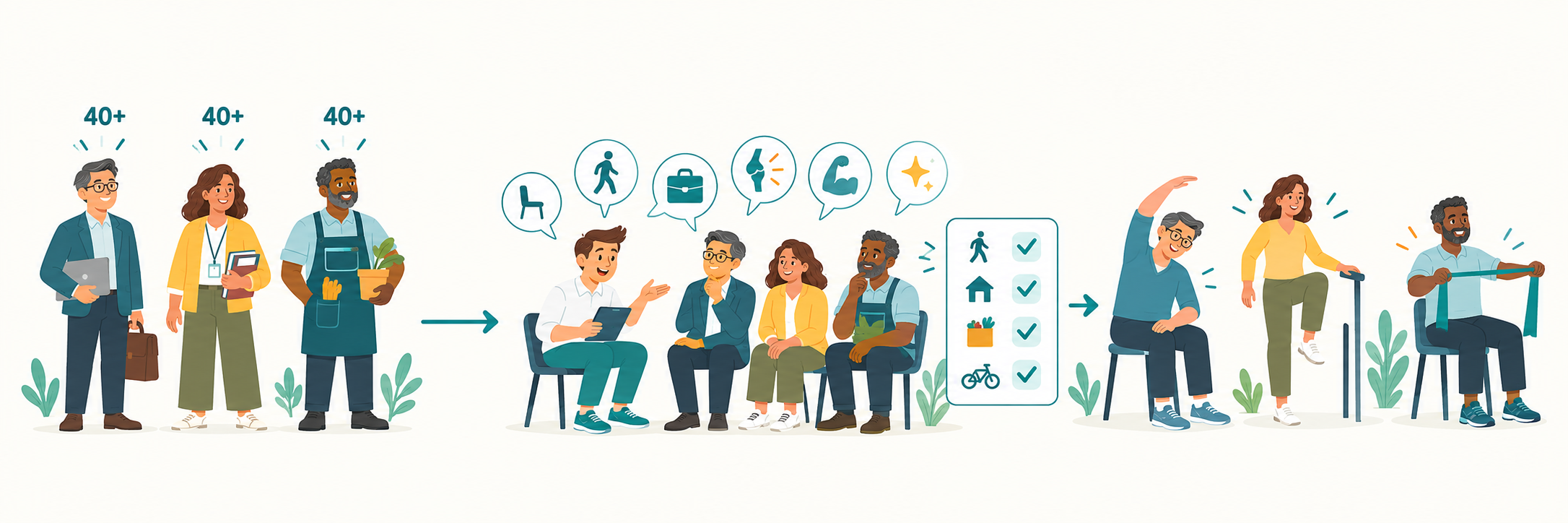
LifeFit taught me to look beyond age and consider profession, daily routine, current activity, confidence, comfort, physical limitations, and responsibilities. Everyday activity can be logged as context and progress; the workouts themselves are structured recommendations shaped by the assessment.
What I would validate next
01 Test the assessment and workout journey with adults of varied abilities and digital confidence.
02 Check whether plans, controls, and difficulty feedback are understandable and usable.
03 Seek qualified exercise and clinical review of guidance, assessment logic, and referral needs.
Make healthier habits feel approachable, so people can keep enjoying the everyday activities that matter to them.
08 / RESEARCH REFERENCES
Sources & further reading
Secondary sources consulted while developing and documenting the concept. These references informed the framing; they are not a substitute for primary user research or clinical validation.
WHO guidelines on physical activity and sedentary behaviour ↗
Recommendations covering adults, older adults, chronic conditions and disability.
WHO brief: physical activity and sedentary behaviour for older people ↗
Older-adult guidance addressing functional ability, falls and osteoporosis.
WHO fact sheet: Falls ↗
Context on fall-related injury, older adults and prevention.
WHO fact sheet: Noncommunicable diseases ↗
Background on chronic diseases and modifiable behavioural risk factors.
Levine: Non-exercise activity thermogenesis ↗
Foundational review defining energy expenditure from daily activity outside structured exercise.
NEXT CASE STUDY
LifeFit Design System
Built for consistency. Designed to scale.
Vignesh Vijayendran / vignesh966@gmail.com
← Back to work
PRODUCT DESIGN / HEALTH & WELLBEING
LifeFit
An approachable fitness experience
for adults above 40.
A safety-conscious design concept exploring how manageable routines, clear guidance, and personal preferences can make fitness easier to begin.

9:41


Workout details
DAY 1
Lower-body strength reset
A joint-friendly session to strengthen your legs, improve balance, and make everyday movement feel easier.
28 min
DURATION
160 kcal
ENERGY
Chair
EQUIPMENT
Seated
POSITION
What you'll work on
Leg strength
Sit and stand
Balance
Steady support
Mobility
Comfortable range

Move at a comfortable pace
Use the chair for support and pause if you feel pain or dizziness.
Exercises
Warm-up
Seated shoulder rolls
45 sec

Ankle and knee mobility
2 min

Main exercises
Chair-assisted squats
3 sets · 8 reps

Seated knee extensions
2 sets · 10 reps

Supported calf raises
2 sets · 10 reps

Cool-down
Seated hamstring stretch
2 min

Calm breathing
1 min

9:41

My plan
Your personalized weekly routine

V
WEEK 1 • PERSONALIZED PLAN
2 of 4 workouts
50%
This week
2 of 4 workouts
Mon
24
Tue
25
Wed
26
Thu
27
Fri
28
Sat
29
Sun
30
Your week
Manage
TUE
25
Lower-body strength reset
28 min • Beginner
Completed
THU
27
Chair mobility flow
20 min • Gentle
Today
SAT
29
Posture and balance
24 min • Beginner
Upcoming
SUN
30
Indoor walking
18 min • Easy
Upcoming
Plan focus
Strength
2 sessions
Mobility
1 session
Balance
1 session
Your plan adapts with you
Workout difficulty and recovery days adjust using your feedback and progress.

Home

Workouts

Plan

Profile
9:41

Good morning, Vignesh
Your personalized plan is ready.

V
WEEK 1 • PERSONALIZED PLAN
2 of 4 workouts
50%
Today’s workout
View plan
DAY 1
Lower-body strength reset
28 min • Beginner • Chair
Start Workout
This week
2 of 4 workouts
Mon
24
Tue
25
Wed
26
Thu
27
Fri
28
Sat
29
Sun
30
Support your day


Recovery
Ready to train

Recovery
Ready to train
Weekly progress
View plan
Your first week
2 of 4 workouts


TODAY
Lower-body strength reset
›

THU
Mobility & balance
›
SAT
Upper-body posture
›
SUN
Recovery walk
›


50%

Home

Workouts

Plan

Profile
I took LifeFit from an initial idea to an interactive prototype, owning product framing, secondary research, information architecture, user flows, UI design, the design system, and prototyping.
01 / WHY I STARTED
A personal question about living well beyond 40.
LifeFit began with a question: how can we help people stay strong, active, and independent as they grow older?
With my mother in her 60s, this curiosity became deeply personal. I started thinking about everyday movement, nutrition, and sustainable habits that could support her health and confidence.
My intention was simple: help people build healthier habits so they can keep doing the things they enjoy and spend meaningful time with family.
02 / THE PROBLEM I OBSERVED
Small steps often go unnoticed.
From my perspective, walking to a nearby shop, carrying groceries, or choosing a more nourishing meal could feel too ordinary to count as part of a healthier routine.
When fitness is understood mainly as structured exercise, getting started can feel like a bigger commitment than it needs to be. I wanted to explore how small, manageable changes could feel worth taking.
Who I designed for
Adults above 40 who want to build healthier habits without making fitness the centre of their lives, with varied abilities, routines, and confidence. This is an initial audience focus, not a validated persona.
03 / THE DESIGN CHALLENGE
How might we help adults above 40 build healthier habits through manageable, safety-conscious plans that fit their bodies and everyday lives?
Understand each person’s starting point, offer realistic choices, and make room to pause, stop, or respond to difficulty. The goal is support, not pressure to finish.
04 / RESEARCH & EARLY UNDERSTANDING
Secondary research. Everyday observation.
I explored healthy aging, activity, strength, balance, and nutrition through online research. Alongside this, I informally observed adults training at the same gyms as me in Bangalore. Thinking about my mother’s health added a personal lens.
These inputs helped frame the initial direction. I did not conduct a formal interview study; the assumptions guiding LifeFit remain unvalidated.
Original references are pending recovery. Follow-up reading will be identified separately.
05 / EARLY INSIGHTS & DESIGN PRINCIPLES
A supportive experience, by intention.
Start small. Make the next step clear.
Recognize manageable effort and avoid making the first step feel like a major commitment.
Understand the person, not just their age.
Consider activity, strength, limitations, comfort, and practical preferences before shaping a plan.
Keep users in control.
Make pause and exit accessible. Capture difficulty without pressuring people to complete a session.
Make consistency visible.
Show completed effort clearly. Treat these principles as hypotheses to test, not proven outcomes.
06 / THE DESIGNED SOLUTION
Understand before recommending.
The assessment looks beyond age: daily activity, perceived exertion, strength, health considerations, areas to avoid, recovery needs, and preferences.
Start with familiar experience
A 20-minute walk question gives people an everyday reference for perceived exertion. Intended to make self-reporting easier, not act as a clinical test.
Acknowledge limitations early
Areas users wish to avoid bring physical considerations into planning. Exercise-selection rules still need qualified review.
Offer ways to participate
Standing, seated, and mixed preferences acknowledge different comfort levels. Intended to make starting feel more approachable.
THE EXPERIENCE / PERSONALIZED PLAN
One clear next step, within a weekly routine.
After assessment, the plan-ready transition lets users choose View Plan. Today’s workout then brings the activity, duration, level, and start action together, while weekly progress provides context.
THE EXPERIENCE / WORKOUT & FEEDBACK
Guidance without pressure to keep going.
Visual instructions, a timer, and audio guidance support the workout. Pause and Exit keep control with the user. Afterward, Easy / Just right / Hard captures how the session felt.
DURING WORKOUT
Guidance that stays in reach
01
Guidance in context
Visual demonstration and movement cues support the exercise.
02
Control stays visible
Previous, Pause, Next and Exit remain available.
03
Audio support
Audio guidance provides another way to follow along.
Keep users in control.
Intended benefit: make guidance easier to follow while allowing a break or an early stop.
AFTER WORKOUT
Feedback that informs the next step
01
Recognize effort
Completion and weekly progress acknowledge the session.
02
Capture difficulty
Easy, Just right and Hard record perceived challenge.
03
Return to the plan
A clear action takes users back to their routine.
Recognize effort and listen.
Intended benefit: capture perceived difficulty to inform future adjustments.
PROTOTYPE SCOPE / Sample plans demonstrate the journey. Personalized plan generation, adaptive adjustments, and health outcomes are not implemented or validated. Everyday activity logging remains a future opportunity.
07 / REFLECTION & NEXT STEPS
Designing for healthy aging meant looking beyond age.
LifeFit taught me to look beyond age and consider profession, daily routine, current activity, confidence, comfort, physical limitations, and responsibilities. Everyday activity can be logged as context and progress; the workouts themselves are structured recommendations shaped by the assessment.
What I would validate next
01 Test the assessment and workout journey with adults of varied abilities and digital confidence.
02 Check whether plans, controls, and difficulty feedback are understandable and usable.
03 Seek qualified exercise and clinical review of guidance, assessment logic, and referral needs.
Make healthier habits feel approachable, so people can keep enjoying the everyday activities that matter to them.
08 / RESEARCH REFERENCES
Sources & further reading
Secondary sources consulted while developing and documenting the concept. These references informed the framing; they are not a substitute for primary user research or clinical validation.
WHO guidelines on physical activity and sedentary behaviour ↗
Recommendations covering adults, older adults, chronic conditions and disability.
WHO brief: physical activity and sedentary behaviour for older people ↗
Older-adult guidance addressing functional ability, falls and osteoporosis.
WHO fact sheet: Falls ↗
Context on fall-related injury, older adults and prevention.
WHO fact sheet: Noncommunicable diseases ↗
Background on chronic diseases and modifiable behavioural risk factors.
Levine: Non-exercise activity thermogenesis ↗
Foundational review defining energy expenditure from daily activity outside structured exercise.
NEXT CASE STUDY
LifeFit Design System
Built for consistency. Designed to scale.
Vignesh Vijayendran / vignesh966@gmail.com
← Back to work
PRODUCT DESIGN / HEALTH & WELLBEING
LifeFit
An approachable fitness experience
for adults above 40.
A safety-conscious design concept exploring how manageable routines, clear guidance, and personal preferences can make fitness easier to begin.

9:41


Workout details
DAY 1
Lower-body strength reset
A joint-friendly session to strengthen your legs, improve balance, and make everyday movement feel easier.
28 min
DURATION
160 kcal
ENERGY
Chair
EQUIPMENT
Seated
POSITION
What you'll work on
Leg strength
Sit and stand
Balance
Steady support
Mobility
Comfortable range

Move at a comfortable pace
Use the chair for support and pause if you feel pain or dizziness.
Exercises
Warm-up
Seated shoulder rolls
45 sec

Ankle and knee mobility
2 min

Main exercises
Chair-assisted squats
3 sets · 8 reps

Seated knee extensions
2 sets · 10 reps

Supported calf raises
2 sets · 10 reps

Cool-down
Seated hamstring stretch
2 min

Calm breathing
1 min

9:41

My plan
Your personalized weekly routine

V
WEEK 1 • PERSONALIZED PLAN
2 of 4 workouts
50%
This week
2 of 4 workouts
Mon
24
Tue
25
Wed
26
Thu
27
Fri
28
Sat
29
Sun
30
Your week
Manage
TUE
25
Lower-body strength reset
28 min • Beginner
Completed
THU
27
Chair mobility flow
20 min • Gentle
Today
SAT
29
Posture and balance
24 min • Beginner
Upcoming
SUN
30
Indoor walking
18 min • Easy
Upcoming
Plan focus
Strength
2 sessions
Mobility
1 session
Balance
1 session
Your plan adapts with you
Workout difficulty and recovery days adjust using your feedback and progress.

Home

Workouts

Plan

Profile
9:41

Good morning, Vignesh
Your personalized plan is ready.

V
WEEK 1 • PERSONALIZED PLAN
2 of 4 workouts
50%
Today’s workout
View plan
DAY 1
Lower-body strength reset
28 min • Beginner • Chair
Start Workout
This week
2 of 4 workouts
Mon
24
Tue
25
Wed
26
Thu
27
Fri
28
Sat
29
Sun
30
Support your day


Recovery
Ready to train

Recovery
Ready to train
Weekly progress
View plan
Your first week
2 of 4 workouts


TODAY
Lower-body strength reset
›

THU
Mobility & balance
›
SAT
Upper-body posture
›
SUN
Recovery walk
›


50%

Home

Workouts

Plan

Profile
I took LifeFit from an initial idea to an interactive prototype, owning product framing, secondary research, information architecture, user flows, UI design, the design system, and prototyping.
01 / WHY I STARTED
A personal question about living well beyond 40.
LifeFit began with a question: how can we help people stay strong, active, and independent as they grow older?
With my mother in her 60s, this curiosity became deeply personal. I started thinking about everyday movement, nutrition, and sustainable habits that could support her health and confidence.
My intention was simple: help people build healthier habits so they can keep doing the things they enjoy and spend meaningful time with family.
02 / THE PROBLEM I OBSERVED
Small steps often go unnoticed.
From my perspective, walking to a nearby shop, carrying groceries, or choosing a more nourishing meal could feel too ordinary to count as part of a healthier routine.
When fitness is understood mainly as structured exercise, getting started can feel like a bigger commitment than it needs to be. I wanted to explore how small, manageable changes could feel worth taking.
Who I designed for
Adults above 40 who want to build healthier habits without making fitness the centre of their lives, with varied abilities, routines, and confidence. This is an initial audience focus, not a validated persona.
03 / THE DESIGN CHALLENGE
How might we help adults above 40 build healthier habits through manageable, safety-conscious plans that fit their bodies and everyday lives?
Understand each person’s starting point, offer realistic choices, and make room to pause, stop, or respond to difficulty. The goal is support, not pressure to finish.
04 / RESEARCH & EARLY UNDERSTANDING
Secondary research. Everyday observation.
I explored healthy aging, activity, strength, balance, and nutrition through online research. Alongside this, I informally observed adults training at the same gyms as me in Bangalore. Thinking about my mother’s health added a personal lens.
These inputs helped frame the initial direction. I did not conduct a formal interview study; the assumptions guiding LifeFit remain unvalidated.
Original references are pending recovery. Follow-up reading will be identified separately.
05 / EARLY INSIGHTS & DESIGN PRINCIPLES
A supportive experience, by intention.
Start small. Make the next step clear.
Recognize manageable effort and avoid making the first step feel like a major commitment.
Understand the person, not just their age.
Consider activity, strength, limitations, comfort, and practical preferences before shaping a plan.
Keep users in control.
Make pause and exit accessible. Capture difficulty without pressuring people to complete a session.
Make consistency visible.
Show completed effort clearly. Treat these principles as hypotheses to test, not proven outcomes.
06 / THE DESIGNED SOLUTION
Understand before recommending.
The assessment looks beyond age: daily activity, perceived exertion, strength, health considerations, areas to avoid, recovery needs, and preferences.
Start with familiar experience
A 20-minute walk question gives people an everyday reference for perceived exertion. Intended to make self-reporting easier, not act as a clinical test.
Acknowledge limitations early
Areas users wish to avoid bring physical considerations into planning. Exercise-selection rules still need qualified review.
Offer ways to participate
Standing, seated, and mixed preferences acknowledge different comfort levels. Intended to make starting feel more approachable.
THE EXPERIENCE / PERSONALIZED PLAN
One clear next step, within a weekly routine.
After assessment, the plan-ready transition lets users choose View Plan. Today’s workout then brings the activity, duration, level, and start action together, while weekly progress provides context.
THE EXPERIENCE / WORKOUT & FEEDBACK
Guidance without pressure to keep going.
Visual instructions, a timer, and audio guidance support the workout. Pause and Exit keep control with the user. Afterward, Easy / Just right / Hard captures how the session felt.
DURING WORKOUT
Guidance that stays in reach
01
Guidance in context
Visual demonstration and movement cues support the exercise.
02
Control stays visible
Previous, Pause, Next and Exit remain available.
03
Audio support
Audio guidance provides another way to follow along.
AFTER WORKOUT
Feedback that informs the next step
01
Recognize effort
Completion and weekly progress acknowledge the session.
02
Capture difficulty
Easy, Just right and Hard record perceived challenge.
03
Return to the plan
A clear action takes users back to their routine.
Keep users in control.
Intended benefit: make guidance easier to follow while allowing a break or an early stop.
Recognize effort and listen.
Intended benefit: capture perceived difficulty to inform future adjustments.
PROTOTYPE SCOPE / Sample plans demonstrate the journey. Personalized plan generation, adaptive adjustments, and health outcomes are not implemented or validated. Everyday activity logging remains a future opportunity.
07 / REFLECTION & NEXT STEPS
Designing for healthy aging meant looking beyond age.
LifeFit taught me to look beyond age and consider profession, daily routine, current activity, confidence, comfort, physical limitations, and responsibilities. Everyday activity can be logged as context and progress; the workouts themselves are structured recommendations shaped by the assessment.
What I would validate next
01 Test the assessment and workout journey with adults of varied abilities and digital confidence.
02 Check whether plans, controls, and difficulty feedback are understandable and usable.
03 Seek qualified exercise and clinical review of guidance, assessment logic, and referral needs.
Make healthier habits feel approachable, so people can keep enjoying the everyday activities that matter to them.
08 / RESEARCH REFERENCES
Sources & further reading
Secondary sources consulted while developing and documenting the concept. These references informed the framing; they are not a substitute for primary user research or clinical validation.
WHO guidelines on physical activity and sedentary behaviour ↗
Recommendations covering adults, older adults, chronic conditions and disability.
WHO brief: physical activity and sedentary behaviour for older people ↗
Older-adult guidance addressing functional ability, falls and osteoporosis.
WHO fact sheet: Falls ↗
Context on fall-related injury, older adults and prevention.
WHO fact sheet: Noncommunicable diseases ↗
Background on chronic diseases and modifiable behavioural risk factors.
Levine: Non-exercise activity thermogenesis ↗
Foundational review defining energy expenditure from daily activity outside structured exercise.
NEXT CASE STUDY
LifeFit Design System
Built for consistency. Designed to scale.
Vignesh Vijayendran / vignesh966@gmail.com